I will provide a China factory product spec sheet template to stop the supplier from using wrong materials
 New
Sales 0

Sold by FirstFactorySystem •Your NDA won’t protect you in China. Five protection layers will. Built for first-time founders. Total sales 0
You just approved the sample. The factory is asking for the production deposit. And you have nothing in writing specifying which grade of material they must use.
That is the deposit-stage gap. And it is where most first orders go wrong.
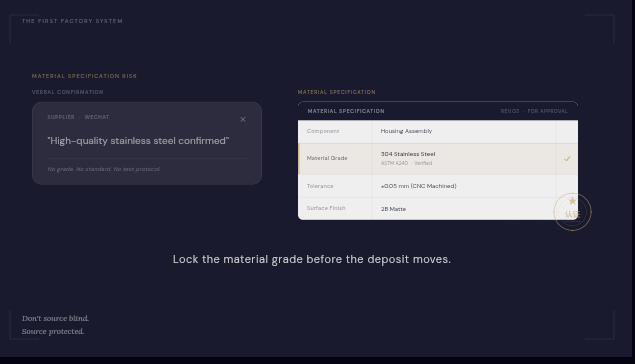
Here is what it looks like in practice. You are sourcing a stainless steel water bottle. You tell the factory in chat that you want high-quality stainless steel. The factory hears standard material. They use Grade 201. You needed Grade 304. Grade 201 rusts under food contact conditions. Grade 304 does not. When your first customers post photos of rust forming inside the bottle within two weeks of use, you contact the factory. Their position is simple and legally defensible: you said stainless steel. They used stainless steel. You have no written document specifying the grade. You have no recourse.
This is not a rare edge case. Material substitution on small first orders is more common than on large ones. Large orders get factory attention. Small orders get standard production settings and standard materials because the factory's margin is thin.
The Bilingual Master Spec Sheet Blueprint closes this gap. It is the signed, chopped, bilingual specification baseline that defines exactly what the factory is legally required to build before your production deposit moves. It sits between the NNN agreement and the sample evaluation stage. The NNN governs what the factory cannot do with your design. The spec sheet governs what they are required to build. Both must exist before the deposit moves.
THE SAMPLE IS NOT A PRODUCTION STANDARD
A sample is built by a technician trying to win your business. It is built under careful attention, with the material and finish that match what was discussed. The production run is built by machines set to whatever standard is cheapest for the factory.
Without a written material grade, the factory has no legal obligation to use what was agreed in conversation. Without a written dimensional tolerance range, there is no defined acceptable drift. Without a written cosmetic standard, there is no reference point for a quality dispute.
Three things happen between sample approval and production completion. The factory sets up the machine for your order using their standard production settings. The production run begins with no signed specification defining acceptable variation. The goods are packaged, and the factory sends photos of finished inventory and asks for the balance.
By the time you open the cartons and discover the problem, the conversation has become a negotiation with a factory that is already fully paid. The leverage is gone.
The spec sheet converts every verbal agreement into a signed, chopped legal commitment before any deposit leaves your account.
WHAT YOU RECEIVE
The Bilingual Master Spec Sheet Blueprint delivers five specification elements in a complete, bilingual, editable document that you send to the factory for signature and Company Chop before the production deposit is authorised.
ELEMENT 1: Material and Component Specification Matrix. The exact material grade, component sourcing standard, and substitution prohibition in a bilingual signed document. The factory specifying Grade 304 stainless steel in a signed, stamped document is a different commitment from agreeing to it in an Alibaba chat message. One is a conversation. The other is an enforceable legal baseline.
ELEMENT 2: Dimensional Tolerance Table. Specific pass and fail ranges per key dimension: length, width, height, weight, wall thickness, with an allowable drift percentage per dimension. Without a signed tolerance table, a factory that produces a component four millimetres short has done nothing provably wrong. With it, every unit outside the range is a documented defect you can enforce against before the balance is released.
ELEMENT 3: Cosmetic and Finish Standard. Colour reference by Pantone code or hex value. Surface quality classification. Logo placement coordinates. Ink adhesion standard. Cosmetic reject threshold. The factory that applied the cheapest ink and cracked your logo on the first wash was never given a written ink adhesion standard. This element is what prevents that outcome.
ELEMENT 4: Packaging Specification. Box dimensions and material grade. Label placement and content. Barcode standard. Inner packing configuration. Carton marking requirements. Packaging defects that allow product damage in transit are entirely preventable when the packaging specification is defined in writing before production begins.
ELEMENT 5: Delivery Protocol. The exact script and sequence for sending the spec sheet to the factory, requiring signature and Company Chop from the authorised plant manager, and confirming receipt before any payment is released. The spec sheet cannot protect you if it is never signed. This element is what gets it back to you, signed and chopped, before the deposit moves.
THE COMPANY CHOP REQUIREMENT
The spec sheet must carry the official Company Chop: the red circular corporate seal of the manufacturing entity. A signature from the factory sales representative is not sufficient. Under Chinese corporate law, an individual employee's signature does not bind the corporation. The Company Chop is what ties the signed commitment to the legal business entity and makes the specification enforceable in a Chinese court. Without it, the document is a conversation in writing, not a legally binding production baseline.
WHO THIS IS FOR
This document is for you if you have completed your supplier vetting and NNN agreement and you are approaching the production deposit stage with no written specification baseline in place.
It is also for you if you have received defective goods from a previous factory relationship where the material or dimensions were not what you agreed in conversation, and you want a structured specification framework for the next production run.
This is not a legal service, not a quality inspection, and not a sample evaluation protocol. It covers one moment: the moment before the production deposit moves.
THE INVESTMENT
My name is Ayoola, founder of Validate First and creator of The First Factory System. This system was built from real buyer research across ecommerce and FBA communities. As one experienced sourcing professional in the community put it directly: I use product specification guides with all of my manufacturers, specifically stating every detail and nuance and how the product should be.
A manufacturing lawyer charges $549.26 to $1,647.77 to draft one product specification document. That covers the document only, for one factory relationship. The Bilingual Master Spec Sheet Blueprint gives you the complete bilingual framework, the tolerance matrix, the cosmetic standard, the packaging specification, and the delivery protocol for €50. It is reusable across every factory relationship you manage.
Before you order, send me a message, and I will deliver the free Pre-Sourcing Preparation guide from The First Factory System. It covers the correct protection sequence across the full factory relationship and is the best way to see the quality and specificity of what you are investing in.
Place your order and receive your complete Bilingual Master Spec Sheet Blueprint as a downloadable file within 24 hours.
Do not source blind. Source protected.
Q: Does this replace the NNN agreement?
A: No. These are two separate documents for two separate decisions. The NNN agreement governs what the factory cannot do with your design. The spec sheet governs what they are legally required to build. Both must exist before the deposit moves. If you do not yet have an NNN agreement in place, the core First Factory System includes the bilingual NNN template as one of its six documents.
Q: What if the factory refuses to sign the spec sheet?
A: A factory that will not commit in writing to the material grade, dimensions, and cosmetic standard before receiving your deposit is showing you a production-stage red flag. Legitimate export-focused manufacturers deal with product specification documents regularly. A refusal to sign is a signal about how they will handle quality disputes after the deposit is paid.
Q: Does this work for any type of product?
A: Yes. The five elements in the spec sheet cover material grade, dimensions, cosmetic finish, packaging, and the delivery protocol. You fill in the English fields with your specific product data. The document is designed to work across product categories including electronics, apparel, kitchenware, fitness equipment, and consumer goods.
Q: I am only ordering 500 units. Is a spec sheet really necessary for a small order?
A: Small orders receive less factory attention, not more. A 2,000-unit order gets quality oversight because the relationship is worth protecting. A 500-unit order gets standard production settings and standard materials because the factory's margin is tight. Material substitution is more common on small first orders than on large ones. At €50, the spec sheet is a fraction of your total order cost and the only document that creates an enforceable production baseline before the deposit moves.
Q: What if I do not have exact Pantone codes or technical drawings yet?
A: Fill in the fields you have. For fields where you do not yet have precise specifications, the product includes guidance on how to request the technical input from the factory before the document is finalised. The spec sheet is a collaborative document: the factory's lead engineer confirms the tolerances their machines can hold before they sign it.
Q: Can I see a sample before ordering?
A: Yes. Send me a message before placing your order, and I will deliver the free Pre-Sourcing Preparation guide from The First Factory System. It is the first part of the full system and covers the correct protection sequence across the full factory relationship, including where the spec sheet fits.