I will provide China pre-shipment quality inspection defect matrix to protect your final payment
 Nouveau
Vente 0

Proposé par FirstFactorySystem •Your NDA won’t protect you in China. Five protection layers will. Built for first-time founders. Vente au total 0
The factory says production is done. They sent photos of packaged goods. Everything in the photos looks fine. You are about to wire the balance.
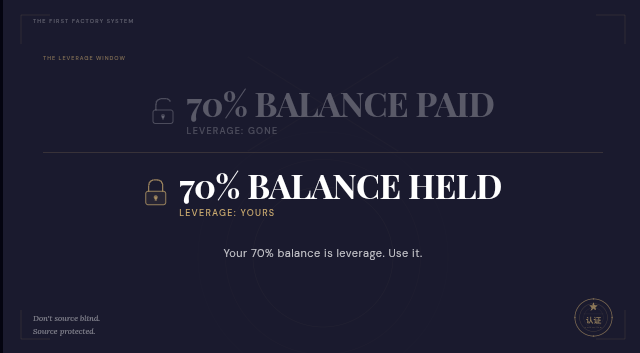
This is the moment the leverage is gone.
Once that final payment clears, the factory is fully paid. If you open the cartons and find defective inventory, the factory has no financial incentive to fix anything. The window to force a rework without a legal dispute closes the moment that balance moves.
This toolkit keeps that window open until a third-party inspector confirms the production run meets your standard.
WHAT HAPPENS WITHOUT AN INSPECTION
Here is what it looks like in practice.
You order 1,000 units of a branded wireless earbuds set from a factory in Shenzhen. You pay the 30 percent deposit. Production runs for six weeks. The factory says production is complete and sends photos of packaged inventory. You wire the remaining 70 percent balance. Total spent: 5 492,55 $US.
The shipment arrives. You open the cartons. Roughly 350 units have a loose left earbud hinge that clicks and wobbles. The charging pins on 120 units are misaligned and only charge at one specific angle. The packaging printing on 80 units has a colour shift from the approved sample.
You contact the factory. They say: small issues are normal for electronics. We cannot rework for free. You accepted the shipment.
You have 5 492,55 $US of damaged inventory and no leverage left. A single pre-shipment inspection day would have caught every one of these defects before the balance was released. That inspection costs 329,55 $US to 384,48 $US. It protects the 70 percent balance payment on every order you place.
WHAT YOU RECEIVE
The Pre-Shipment QC Inspection and Defect Matrix Toolkit delivers five elements that structure the entire inspection process from booking through balance release.
ELEMENT 1: Critical, Major, and Minor Defect Classification Matrix. This is the document you send to your inspection agency before the inspector arrives. Without it, the agency applies a generic industry standard that may not match your product. With it, the inspector evaluates the production run against your defined standard: what constitutes a critical defect that blocks the entire shipment, what constitutes a major defect counted against the AQL threshold, and what constitutes a minor defect tolerable within a defined limit. You fill in your product-specific defect descriptions before the inspection is booked.
ELEMENT 2: AQL Sampling Plan Decoder. AQL stands for Acceptable Quality Limit. It is the globally recognised statistical method that determines how many units your inspector physically checks and how many defects are acceptable before the batch fails. The decoder breaks this down in plain language for every common e-commerce order size from 50 units to over 3,000. For a 500-unit order at AQL 2.5, your inspector checks 80 units. The acceptance number for major defects is two. Three defects found means the batch fails and your balance holds. You need this number before the report arrives, not after.
ELEMENT 3: QC Inspection Booking Directory and Agent Script. Three trusted inspection agencies with direct booking URLs and guidance on which to use for your product type. QIMA for ecommerce starters, the most widely used platform for first-time founders. V-Trust for hardware and electronics requiring engineering-level scrutiny. SGS for products requiring regulatory lab certifications, including CE, FCC, or FDA. The standard rate across all three is 329,55 $US to 384,48 $US per man-day, with travel costs and the final PDF inspection report included for factories in major manufacturing provinces. Includes the complete copy-paste Inspection Design Brief template to upload when booking, specific testing instructions including the ISTA-1A carton drop-test from 76 centimetres, the logo tape-peel check, and the digital caliper specification benchmark.
ELEMENT 4: Bilingual Balance-Hold Script. Used only when the inspection report shows a fail result. Sent to the factory via the Alibaba Message Centre within 24 hours of receiving the report. The script states three things: the balance is withheld, the specific defects that must be corrected are listed by classification level, and a re-inspection is required before the balance moves. Without this script, a failed inspection becomes a negotiation. With it, the factory receives a formal written notice in both English and Chinese that the balance does not move until the rework passes a re-inspection.
ELEMENT 5: Re-Inspection Authorisation Protocol. The exact sequence that releases the balance after a passed re-inspection. Re-inspection report received. Defects confirmed corrected. Balance release authorised in writing via the Alibaba Message Centre. This creates the documented paper trail confirming the balance was released only after the production run met the agreed standard.
THE BOOKING TIMING STRATEGY
This detail is worth noting before you book.
When your factory says production will wrap up next Friday, do not wait until Friday to book. Log in to your inspection agency account the same day and book for the following Monday. This gives the factory a 3-day buffer so they cannot claim the goods are not fully packed when the inspector arrives. It also gives you confirmation of the inspection date before the factory has a chance to push the schedule.
There is a documented quality improvement effect that happens when a factory knows a certified inspector is walking their floor on a named date. Announcing the inspection in writing before it happens is itself a quality intervention.
WHO THIS IS FOR
This toolkit is for you if production is complete or approaching completion and you have not yet released the final balance payment.
It is also for you if you have received defective goods in a previous order after releasing the balance without an inspection, and you want a structured quality control process for the next production run.
This is not an inspection agency. You must still book a third-party inspection service using the agencies listed in the Booking Directory. The toolkit structures the inspection you book. It does not conduct it.
THE INVESTMENT
My name is Ayoola, founder of Validate First and creator of The First Factory System. This toolkit was built from real buyer research across ecommerce and FBA communities. As one supply chain professional with eight years based in Shanghai put it directly: tell the factory you will control the quality with an agent, and make sure to tell them exactly what quality and specificities you expect as standard; else you do not pay. You will see how much better they produce.
A standard pre-shipment inspection day costs 329,55 $US to 384,48 $US. That covers the inspection only. It does not include the Inspection Design Brief, the defect classification matrix, the AQL sampling plan for your order size, or the bilingual balance-hold script. The Pre-Shipment QC Inspection and Defect Matrix Toolkit gives you all of these for €50.
Before you order, send me a message, and I will deliver the free Pre-Sourcing Preparation guide from The First Factory System. It covers the full protection sequence across the factory relationship and shows you exactly where this toolkit fits.
Place your order and receive your complete toolkit as a downloadable file within 24 hours.
Do not source blind. Source protected.
Q: I already booked QIMA. Do I still need this toolkit?
A: QIMA runs the inspection. The toolkit is what tells you which agency to use for your product type, what to send them before they arrive, and what to do if the report comes back as a fail. Without a defect matrix, QIMA applies a generic standard that may not match your product. Without the Inspection Design Brief, the inspector may not run the specific tests your product requires. Without the balance-hold script, a failed inspection becomes a negotiation rather than an enforceable hold. QIMA does the inspection. The toolkit governs how you book it, what they inspect against, and what happens the moment it fails.
Q: What happens if the inspection comes back as a fail?
A: Send the bilingual balance-hold script to the factory via the Alibaba Message Centre within 24 hours of receiving the inspection report. The script withholds the balance, lists the specific defects by classification level, and states that re-inspection is required before the balance is released. Do not send it via WhatsApp or WeChat at this stage. The Alibaba Message Centre creates a timestamped, platform-verified record that is accepted in dispute proceedings. The factory reworks the defective units. You book a re-inspection. The balance moves only after the re-inspection passes.
Q: I am only ordering 300 units. Is an inspection really worth it on a small order?
A: The leverage calculation is straightforward. On a 4 394,04 $US total order, your 70 percent balance is 3 075,83 $US. The inspection costs 329,55 $US to 384,48 $US. If the inspection reveals a fail and the rework is completed, that fee returned 3 075,83 $US in leverage. The order size does not change that calculation. If the batch passes, you release the balance with a written third-party confirmation that the production run met your standard.
Q: What is AQL 2.5 and do I need to understand the statistics behind it?
A: No. The AQL Sampling Plan Decoder in the toolkit breaks it down in plain language for every common order size. All you need to know before booking is which AQL level to request and what the accept number is for your order size. The toolkit gives you both. AQL 2.5 is the confirmed standard for major defects in most ecommerce products. Zero tolerance applies to critical defects. AQL 4.0 applies to minor cosmetic defects.
Q: Can I use the balance-hold script for any factory dispute?
A: The balance-hold script is specifically designed for use when a pre-shipment inspection report shows a fail result. It references the inspection agency, the report findings, and the rework requirement. It is not designed for general quality disputes after the balance has already been paid. The leverage the script protects exists only in the window between production completion and balance payment.
Q: When exactly in the production process should I book the inspection?
A: Book the inspection the moment your factory confirms production will be complete on a named date. Do not wait for production to finish. Book immediately and schedule the inspection for three days after the factory's stated completion date. This 3-day buffer prevents the factory from claiming goods are not fully packed when the inspector arrives, and it gives you a confirmed inspection date before the factory asks for the balance.